

The UNESCO Chair Global Health & Education (GHE) research strategy aims to produce transformative knowledge in health promotion, aligning with its primary ambition to contribute to social change for the health of all, particularly children and young people.
This strategy is designed to support the development of innovative intersectoral policies and practices that improve population health, reduce inequalities, and preserve our planet. The research strategy is built upon the Chair’s four pillars: promoting collaboration, producing knowledge, developing capacity, and sharing knowledge. It leverages the Chair’s global community, which brings together diverse actors from education and health sectors, to create a robust foundation for impactful research.

Two priorities
Two key priorities, transversal to the flagship projects, form the core of this research strategy:
- Development of a Renewed Conceptual Framework: This priority focuses on integrating environmental and social change into health promotion models. It aims to create new paradigms that account for the complex interplay between health, education, and broader societal and environmental factors.
- Research on Key Factors Influencing Local Capacity Building: This priority examines the critical elements that enhance the ability of local communities to implement effective health promotion initiatives. It seeks to understand and optimize the processes that empower communities to take charge of their health from a systemic perspective.
Four flagship programs
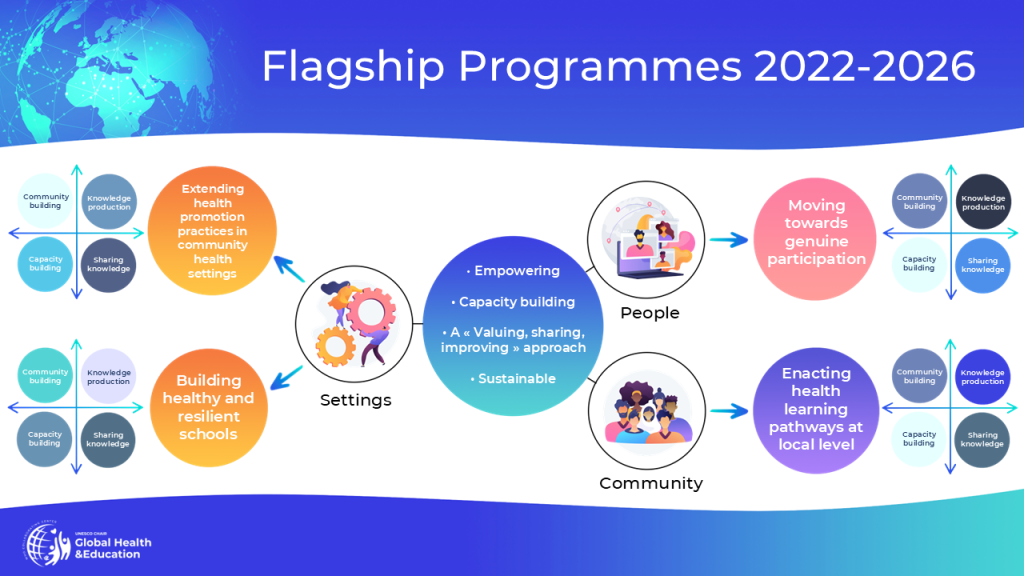
The strategy will be implemented through the Chair’s four flagship programs:
- Extending health promotion practices in community health settings
- Building health and resilient schools
- Moving towards genuine participation
- Enacting health learning pathways at local level
These programs provide concrete areas for applying the research priorities and engaging the global community in collaborative knowledge production.
A main asset
The strategy’s main asset is the Chair’s global community, comprising universities, public and private organizations, professionals, and committed citizens. This diverse network provides a rich source of perspectives, experiences, and expertise, enabling collaborative and cross-cultural research approaches.
Key people
The research programs will involve a wide range of profiles, with a particular focus on professionals embedded in communities who are interested in participating to research. This approach ensures that research is grounded in real-world contexts and directly addresses the needs of populations.
The role of the head of scientific affairs and the board of experts in the research strategy
The head of scientific affairs and the board of experts play a crucial role in the research strategy of the UNESCO Chair Global Health & Education (GHE). As part of its oversight role, the head likely contributes to shaping the overall research strategy, aligning it with the Chair’s mission and objectives. Based on the present note and the summary of the present research activities of the Chair, the head of the scientific affairs will be invited to assess the relevance of the vision embedded in the note and provides expert advice and recommendations on research priorities, methodologies, and emerging areas of interest in the field of global health and education.
By integrating these elements, the UNESCO Chair GHE research strategy aims to produce actionable knowledge that bridges the gap between theory and practice in health promotion, ultimately contributing to significant social change and improved health outcomes for all.