Información en español, Informações em português
Speakers
Moderator
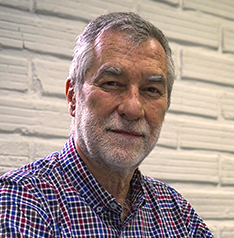
Prof. Dr. Fernando Peñaranda Correa. He is a doctor, holds a master’s degree in public health, a master’s degree in education and social development, and a doctorate in social sciences, childhood and youth. He is a full professor and senior researcher in the Health and Society Research Group at the National School of Public Health at the University of Antioquia. He is the coordinator of the health education emphasis in the Master’s in Public Health programme. He has taught undergraduate and postgraduate programmes at the Faculty and other universities in the country on the following topics: epistemology, qualitative research, ethics and social justice, public health, health promotion, and health education. He has written numerous articles, book chapters, and books in the areas of health education, qualitative research, ethics, public health, and social justice.

Bibiana E. Castro Franco. Psychologist, specialising in social psychology, Master’s degree in Public Health and Doctorate in Human Sciences. Lecturer at the University of Cauca. Department of Education and Pedagogy. Researcher with the Popular and Community Education Group. Member of the Colombian Network for Health Education. CLACSO Working Group on International Health and Health Sovereignty.
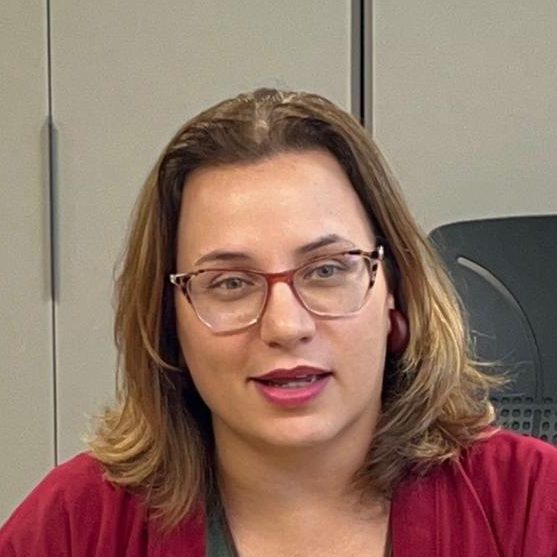
Dr. Kátia Souto. National Coordinator of the School Health Programme, Ministry of Health, Brazil
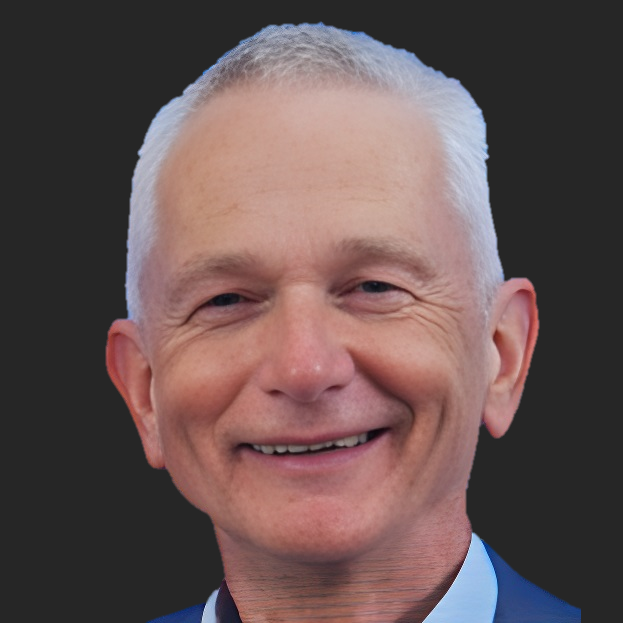
Goof Buijs. Manager of the UNESCO Chair Global Health & Education. After finishing his Master study in Human Nutrition his first job was teaching health science at the Amsterdam teacher trainer institute. Next he moved into the field of health promotion, as health promotion officer in Amsterdam. At the Netherlands Institute for Health Promotion NIGZ he specialized in school health promotion, first on the Dutch level to introduce the national health promoting school programme and leading several European projects. In 2007 he became the manager of the Schools for Health (SHE) network until 2017. In 2018, with prof Didier Jourdan, he set up the UNESCO Chair Global Health & Education, also the WHO Collaborating Centre. His specialisation is bringing health and education sectors together. He is an experienced networker, expert in co-creation, trainer, and organizer of local and global events. He supports cooperation among people, focusing on everyone’s talents and uniqueness. He is an environmental activist for most of his life.
Summary
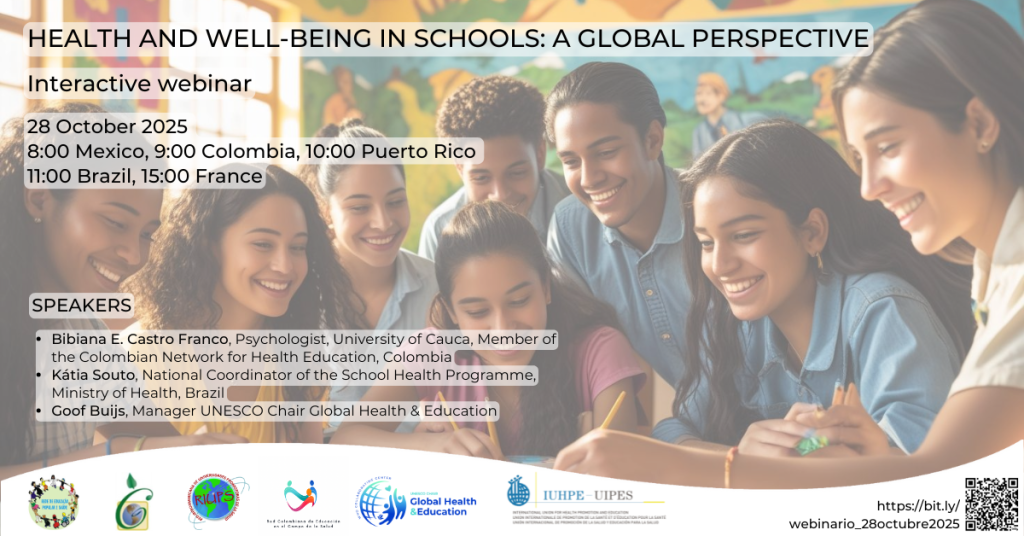
During this webinar the speakers will analyse experiences with health promotion in the education sector in various countries to identify achievements, challenges and opportunities. Each speaker will share their respective experiences, identifying the progress, strengths, difficulties and challenges involved in coordinating the education and health sectors to promote health promotion and health education in schools. This will be followed by time for attendees to ask questions and make comments on the presentations given by the speakers.
Our speaker’s contributions
The recording of the webinar:
Latin American Network for the Revitalisation of Health Education
This webinar is a part of the “Latin American Network for the Revitalisation of Health Education”. This initiative is being promoted with the participation of the UNESCO Chair on Global Health and Education, the Inter-American Consortium of Universities and Training Centers for Health Education and Health Promotion (CIUEPS), the Brazilian Network of Popular Health Education, the Colombian Network of Health Education and the Regional Office for Latin America of the International Union of Health Promotion and Education (IUHPE/ORLA), with the following objectives:
- Promote health education at national and international levels, as a fundamental dimension of the health disciplines, the educational sciences and the social and human sciences.
- To recuperate the Latin American production and position it in the regional level, which implies promoting its critical and decolonial approaches. A health education that advocates for social transformation towards a more just and equitable society that guarantees well-being and a life with dignity.
- Promote the articulation of the education and health sectors to strengthen the actions of each of these sectors to promote health education, by recognizing education and health as two inalienable, synergistic and interdependent human rights.
- Strengthen the theoretical, political and ethical foundations of health education as a requirement for a responsible, productive and ethical pedagogical practice.
- To generate a setting for the articulation of academia and civil society that allows Latin American integration in order to share experiences, knowledge and aspirations framed in a collective purpose.
- To promote national and international integration with respect to health education as a means for mutual learning and solidarity, and to facilitate cooperative actions in the development of academic-scientific events, research and training processes.
The webinars, open to all interested stakeholders, are a component of the program. They are experiential sessions, lasting 60-90 minutes, with guest speakers who present their reflections on two or three problematic questions to encourage audience participation. Five webinars have been scheduled for this first stage of the program, with an interval of 2 months between each one.
Watch the recordings of previous webinars:
- 8 April 2025 – Popular Education and Education Policies in the Field of Health
- 11 February 2025 – Strategies for implementing Health Education in different Latin American settings
- 26 November 2024 – The invisibilization of health education and how it can be revitalized, also recovering Latin American experiences and productions
- 17 September 2024 – Theoretical and political debates on Health Education in Latin America